“A mind that is stretched by a new experience can never go back to its old dimensions.” – Oliver Wendell Holmes S. Portico Bowman is a friend of mine and a talented artist, writer, and teacher. She is also a creative and insightful person. I particularly admire her ability to transition between different media – from pottery to printing to writing, and her insights during our shared travels have helped me to see things differently. Portico is offering a workshop from July 12-16, 2020, at the Hollyhock Retreat Centre on Cortes Island, British Columbia, and I strongly encourage you to take part. The workshop is entitled Drawing Towards the Earth: Making Journals for Life and will involve making coptic stitch Arcadia Playhouse journals and Bargello tapestry bookmarks . The slow, repetitive creative process is designed to be contemplative, meditative, and introspective. In addition, Cortes Island provides the most fabulous garden setting surrounded by the ocean. It sounds absol...
Local Happenings Congratulations to Kathy Evans , department head secretary in the College of Medicine’s Department of Community Health & Epidemiology, who has received the 2019 Sydney Inskip Award. One of the many things Kathy does to establish a welcoming environment in the department and the community is to invite students into her home to cook and share a meal. I worked with Kathy for a short while and she went out of her way to make me feel welcome and to help me obtain contract work once I went freelance. CHEP’s Collective Kitchens Partnership is hosting a Grub ‘n Gab starting at 5:30 pm , Jan. 23 . Following supper, there will be a presentation by Slow Food Saskatoon explaining what slow food is and how it’s tied to culture. Pre-registration is required. Contact Janet at 306-655-4575 or janet@chep.org if you’re interested in attending. Edible Landscapes Permaculture Design and Consulting, Regina, is offering a 3-day course covering edible and medicinal prairie...
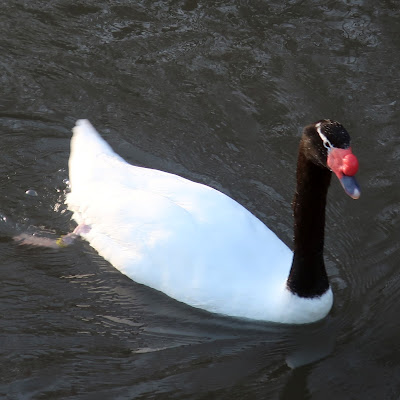
I had the great good fortune to visit the Arundel Wetland Centre yesterday. As a prairie dweller, I was amazed by the huge network of ponds and canals. Even more astonishing, the ponds were lined on either side with reeds that towered over my head. The array of ducks and geese was astonishing – geese elegantly dressed in black and white, small ducks with downy soft feathers, geese with long necks wrapped in swirling stripes. Each pond was designed to suit a different type of waterfowl so there were some with waterfalls and others with large rocks and ledges. The site doesn’t just cater for waterfowl. There were boxes for bats and barn owls as well as insect hotels and big stacks of branches providing shelter for all sorts of animals. There were birdwatching hides and a cabin full of dried herbs to touch and smell. The best part of the visit was a silent electric boat ride through the canals providing a duck’s-eye view of their world. ...
Local Happenings Attend a free public screening of the food waste documentary Just Eat It from 1:45-3 pm , Jan. 31 . Registration is required. An article entitled food bank users deserve luxuries as well as lentils – just like everyone else made me think. I normally make a cash donation so the Saskatoon Food Bank & Learning Centre can purchase what is most needed, but if I do contribute an item, it’s usually something very practical like pasta. Maybe next time it will be chocolate bars. Food for Thought Nature Food is a new online magazine publishing research, reviews, and comments on aspects of food production, processing, distribution, and consumption that impact human and planetary health. There’s a strong UK slant to the articles and many are very research-oriented. The article I enjoyed the most in the first edition was the evolving history of pie and mash shops in the UK . A research experiment asked participants to rate oat biscuits on appearance al...
Local Happenings Happy New Year! I’m so pleased to see that the Saskatoon Farmers’ Market attracted a good crowd at its first market in its temporary location at 2604 Koyl Avenue. Change is hard, but it’s also an opportunity for renewal. I’m hoping that this move will provide the Saskatoon Farmers’ Market Co-operative with a chance to focus on their long-term goal of connecting the urban public with the source of their food. I look forward to seeing new vendors coming forward who really value that connection with the people who eat their food and new customers who are eager to meet the person who grew or baked their food – whether it’s the farmer who tells you about the hailstorm that played havoc with their crop or the baker who tells you about the Mexican festival origins of their different baked goods. There has been an interesting conversation on City Perks’ Facebook page this past week (Jan. 3 post) about ways of reducing the number of disposable coffee cups. S...




Comments