Oh, it does look cold and winter-y there. But those little cranberries nestling by a mushroom are such sparks of bright - almost warmth - in the smaller landscape.
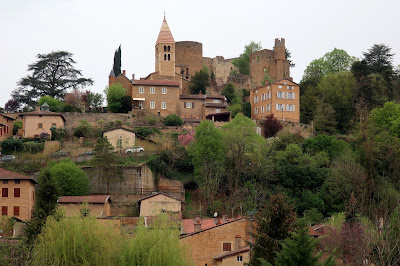
Heading north out of Lyon, you pass through a long tunnel and exit into a lush green countryside leaving the city far behind. You then turn and head up the hill onto winding roads between a patchwork of vineyards. Many of the vines are really old with short, thick, twisted trunks and a thin stem of green leaves and buds. These are the Gamay vines of Beaujolais, interspersed with a few fields of greener, leafier Chardonnay vines. South Beaujolais, just 45 minutes northwest of Lyon, encompasses 25 medieval villages of orangey-gold stone (limestone and iron) that is surprisingly vibrant (I had been expecting something lighter, similar to the Cotswolds in England). Some of the villages still have the remains of 14th century castles. Oingt is classed as one of the most beautiful villages of France and it really is lovely. You can take a walk around the town on the former ramparts and the church is austere and beautiful. I was on a half-day tour , which combined stopping to...
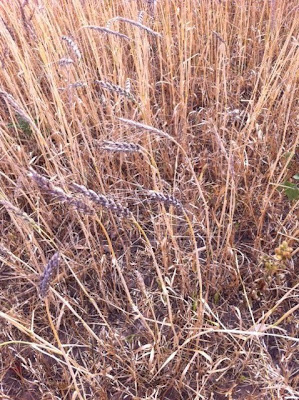
When I was growing up, whole wheat flour and rice were exotic options. Now we have a whole range of intriguing choices – buckwheat, spelt, millet, kamut – the list goes on and on. My problem is that I don’t know very much about some of these grains, so I arranged a phone call with Nicole Davis, the Owner/Manager of Daybreak Mill near Estevan. Daybreak Mill grows and processes approximately 18 different kinds of flour, whole and de-hulled grains, flakes, cereals, and legumes. They are 100% organic. “We want people to have access to healthy, wholesome food,” Nicole explains. Two of Daybreak’s products – spelt and millet – have been nourishing people around the world for over 9,000 years. Spelt Spelt was cultivated by ancient civilizations in Europe and the Middle East for thousands of years. It grows well in poor soil and doesn’t require fertilizer. It’s resistant to frost and the thick husk protects the grain from insects. However, spelt requires more processing than wheat as ...
It’s 4 in the morning and Tracey Muzzolini is making bread at Christie’s Bakery on 33rd Street. She’ll be across town, at Broadway and 10th, opening up Il Secondo, the bakery’s second location, by 7 am. The day will pass quickly as she makes and bakes one pizza after another in the wood-fired oven. Her brother and business partner, Blair Muzzolini, will join her at lunchtime. The last call for pizza is at 5:30, and Tracey will be on her way home at 7:30 pm after a 15-hour work day. This is a short-term solution, but it is nonetheless a huge amount of work. “I do get a little tired in the afternoon,” Tracey says. “I’m quite proud of myself for keeping up. The food industry seems romantic, but you have to love it because you put a lot in.” A Baking Tradition The Christie brothers opened Christie’s Bakery in 1932 at its current location at 420 33rd Street West. Tracey’s parents, Janet and Ennio Muzzolini, bought the bakery in 1965, and Tracey and her brother Blair have worked there th...
Tucked away in a strip mall on Primrose Drive (north of Lawson Heights Mall) is Petra Market, a treasure trove of food products from the Arabic countries in the Mediterranean. I’m fascinated by grocery stores full of unknown-to-me products but also a little nervous about trying things, so I was really happy when Nour Dabbour, the owner of Petra Market, showed me around and told me about the different items. Nour is trying to stock products from as many Middle Eastern countries as possible. He even stocks the same product from a number of different countries because he says that each country’s product tastes slightly different. Za’atar , a spice mix, is a prime example with packages from Lebanon, Israel, Jordan, and each one is a slightly different colour with a slightly different taste. The most popular areas of the store are the nut and treats bars with an amazing assortment of Middle Eastern candies and mildly spiced nuts. Nour gave me a variety to try and I’m real...
In most cities, trees are few and far between. But not in Elche. Step out of the train station, and you are immediately greeted by avenues lined with palm trees and by parks, fields and squares full of palm trees of all shapes and sizes. Palmeral The Palmeral of Elche is a UNESCO World Heritage Site. Its palm tree plantation is the largest in Europe covering 3.5 square kilometres, 1.5 of which are within the city limits. There are 200,000 to 300,000 palm trees, some of which are 300 years old. (Palm trees are extremely slow growers. It takes them 100 years to grow to 10 metres in height.) The Phoenicians brought palm trees to Spain in the first century BC and cultivated the dates as food for their long sea journeys. When the Arabs arrived in Spain, they added extensive irrigation systems and landscaping. The City of Elche continues to protect and develop its palmeral, and it’s a delight to walk in the shady parks that are filled with trees and flowers. El Huerto del Cura The Hue...


Comments